
The
Kawasaki Ninja ZX-6R is a Kawasaki 600 class sport motorcycle. It was introduced in 1995, and has been constantly updated throughout the years in response to new products from Honda, Suzuki, and Yamaha. The ZX series is what was known as the Ninja line of Kawasaki motorcycles in the 1980s and still carries the name today.

When Kawasaki introduced the ZX-6R in 1995, it was the first middleweight sport bike, since the 1992 GSXR600 with an aluminum frame. It had a dry weight of 401.2 lb (182.0 kg), wet weight of 454 lb (206 kg), and was capable of accelerating 0 to 60 mph (0 to 97 km/h) in only 3.6 seconds.

There was a major revamp of the ZX-6R in 1998 with the Launch of the G series. The G series saw no increase in displacement but power went from 100 bhp to 108 bhp thanks to the newly designed airbox. Fairing was revamped, but retained a similar design as far as the headlight, air intakes and screen were concerned. In 2000, the first J series replaced the G, increasing power to 112 bhp by increasing the compression ratio from 11.8:1 to 12.8:1. The J series sported a couple of modernisations including a 180 section rear tyre, second headlight, uprated generator and stick coils (coil on plug) replacing the traditional coil with HT lead.

With competition from Honda's CBR600F4i, Suzuki's GSX-R600, and Yamaha's YZF-R6 getting more aggressive, Kawasaki decided to make an unusual move for the late 2002 models. They increased the capacity of the traditional 600 cc (37 cu in) motor to 636 cc (38.8 cu in) with the ZX-6R A1P. This version used the J series bodywork with the only notable differences being the "636" stickers on the fairing. For riders who needed bikes for displacement-restricted racing, Kawasaki also made available a limited production 599 cc (36.6 cu in) version called the Ninja ZX-6RR, but the 636 cubic centimetres (38.8 cu in) ZX-6R would be their main mass production middleweight sport bike.

In 2003, there were a number of changes to the ZX-6R, or ZX636 as it is often referred. The engine was fuel injected and engine speed was raised around 500 rpm which resulted in a slight gain in power. Radial-mounted four-piston brakes replaced the previous six-piston brakes and the front forks were now inverted. Chassis improvements resulted in higher rigidity and less weight. An all digital instrument panel was also introduced and a larger ram air inlet moved to the center over the headlight, running through the headstock. The bike, designation B1H, carried over to the 2004 model year with just color scheme changes. The ZX-6RR won the Supersport category award for Masterbike 2004 and placed third overall.

In 2005, Kawasaki again revamped the ZX-6R. Engine speed increased again by 1,000 rpm resulting in 113 hp (84 kW) at 12250 rpm. The frame and swingarm were updated, but the main changes from its predecessor lay in the design. The aluminum frame was now painted flat black, fairings were more round, and integrated turn signals were used (euro model). The exhaust was now centrally under the seat (a configuration commonly referred to as an undertail exhaust). Most of these changes were mirrored in the 599 cc ZX-6RR. For the second year in a row, the ZX-6RR again won the Supersport category award for Masterbike 2005 and placed third overall. The bike carried over to the 2006 model year with minor suspension changes and new color schemes.

After four years of offering their 636 cc ZX-6R for street use and an entirely separate 599 cc ZX-6RR for displacement-restricted racing classes, Kawasaki offered only one ZX-6R for 2007, and it displaced 599 cc. Previous years of the ZX-6R's engines were all built from the same basic design, but the all-new engine for 2007 was redesigned from the crankcase up. In following with what their competitors had already been doing, Kawasaki's new engine featured a stacked gear arrangement in which the crankshaft, primary drive and countershaft are placed in a triangular format for a shorter, more compact powerplant. Now about 40 mm smaller in both length and width and it is said to yield greater cornering clearance. By using a former 125 cc Grand Prix racer as the ZX-6R’s chief development rider, Tomomi Manako, Kawasaki claims a focus has been put on track usage. Frame, swingarm, suspension, brakes, and body were completely redesigned and the bike shares very few parts from the previous model. The ZX-6R was carried over to the 2008 model year with just color scheme changes.

For 2009, Kawasaki dramatically changed the appearance of the ZX-6R to match the more angular look of the ZX-10R. The frame was lightened albeit with the same basic construction resulting in 191 kg (420 lb) wet as opposed to 205 kg (450 lb) in 2008. Kawasaki claims the new ZX-6R is 10 kg lighter than the previous model. The greatest changes for 2009 were the redesign of the exhaust, now carried low and not requiring the thick under-seat construction of 2008 and especially the introduction of the BPF (Big Piston Fork) suspension from SHOWA for a more progressive brake-dive. The 2010 ZX-6R is changing once more with an improved engine and slipper clutch. The exhaust pre-chamber has more space and also limits exhaust noise giving the rider a smoother ride. New double bore intake funnels features two available heights which gives performance upgrades in both high and low engine speeds. The front seat is now lower.

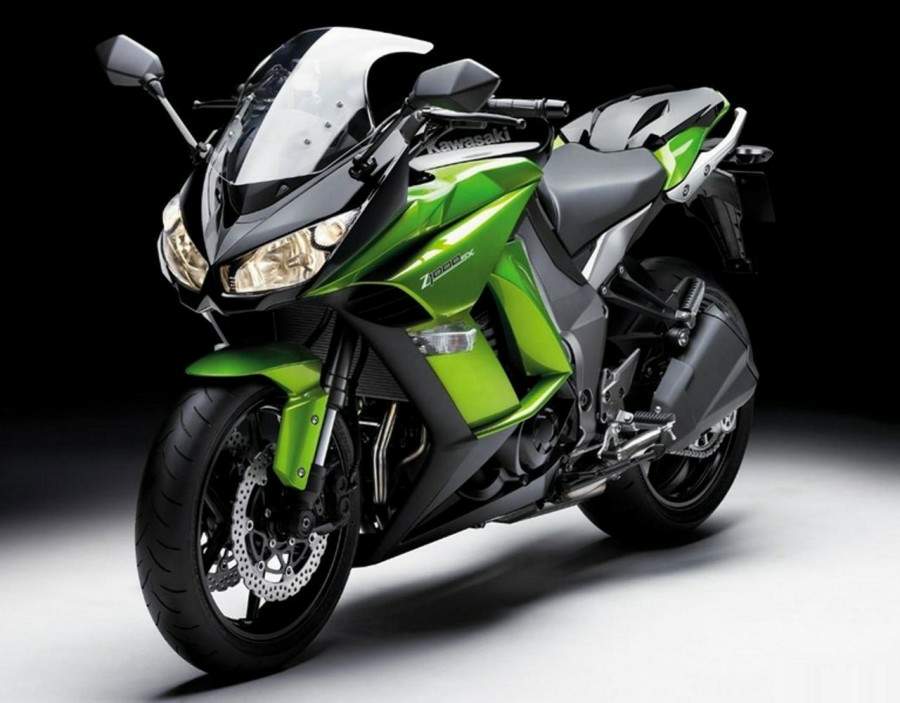 The Kawasaki Z1000 is a four-cylinder motorcycle in the streetfighter or standard style.
 In October 2009, Kawasaki unveiled the 2010 Z1000. It received an all new Aluminum frame, Digital Instrument Panel, Bodywork, and a completely new engine. It sports 77 x 56mm bore and stroke figures, 1mm over the ZX-10R’s 76 x 55mm displacing 1,043cc. That is up from the previous model's 953cc. Compression ratio is 11.8:1, and fuel injection is handled by a bank of 38mm Keihin throttle bodies.


